

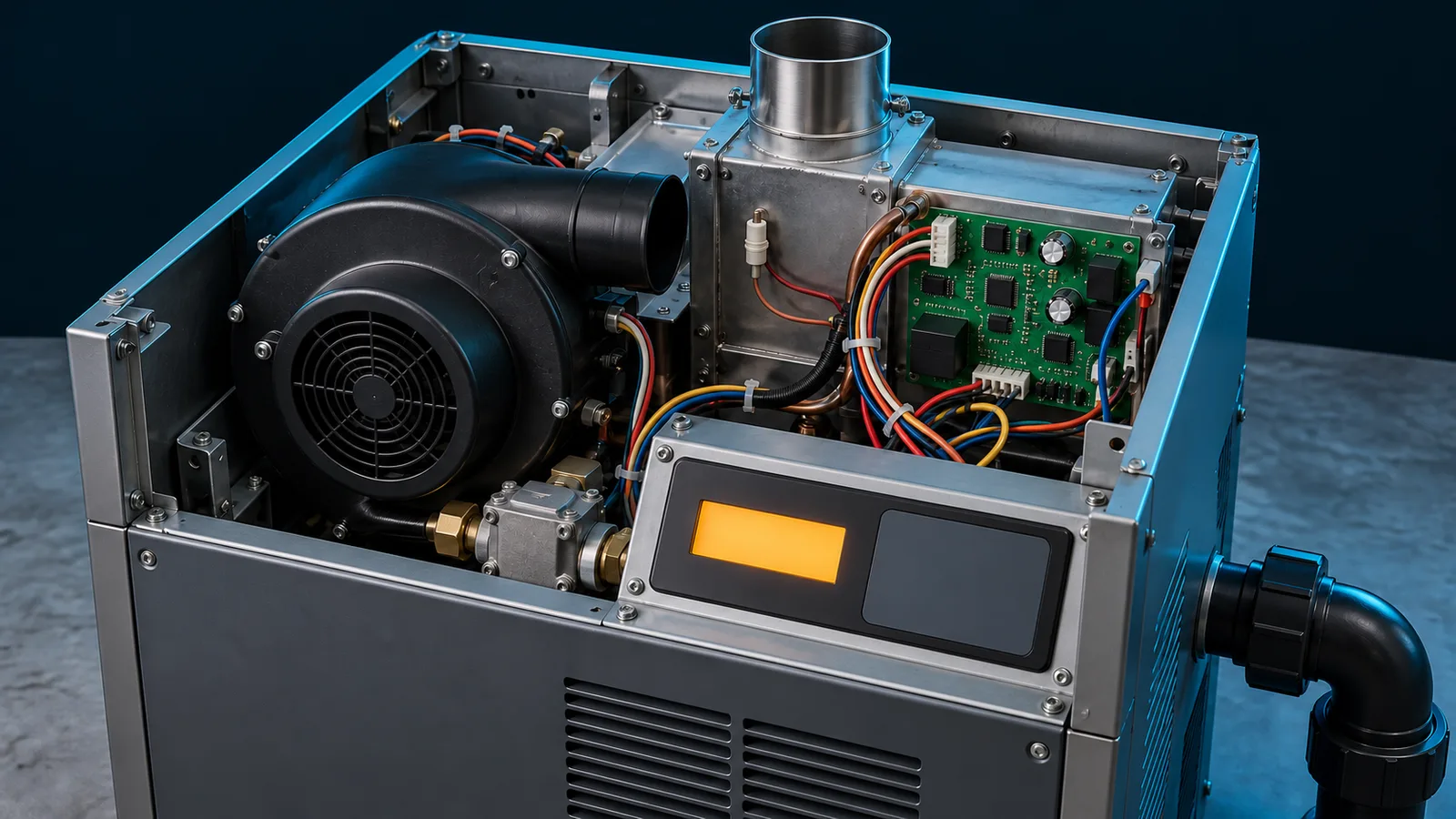
The Pentair MasterTemp and the Sta-Rite Max-E-Therm are the same heater under two badges: the same low-NOx burner, the same finned copper heat exchanger with an internal thermal-regulator bypass, the same control board and membrane pad. So they fail in the same ways and report those failures with the same short vocabulary on the display. A technician who can read that vocabulary walks up to the pad knowing which side of the heater to open — water, air or gas — before the jacket comes off.
This guide goes code by code. For each one: what the controller is actually measuring, what usually trips it, and what to check before condemning a part. At the end is a clear line between the parts a service company can source aftermarket and the parts that should only ever come from the equipment brand.
Reading the panel
When the heater locks out, the Service Heater light comes on and the display alternates between the set-point and a code. The codes fall into two families. The three-letter codes are switches and limits — a contact that should be closed is open. The E-codes are sensor circuits — a thermistor reading open or shorted.
| Code | What the controller saw | Component behind it | Side of the heater |
|---|---|---|---|
PS |
Water pressure switch open | Pressure switch, but almost always flow | Water |
HLS |
Water above the first-pass high limit (about 135°F) | High-limit switch; usually flow or a scaled exchanger | Water |
AGS |
Water above the second-pass limit (about 140°F); automatic gas shutoff | AGS thermal switch; same root causes as HLS, one step worse | Water |
AFS |
Air flow switch open — blower not proving | Blower, pressure-tap tube, vent | Air |
SFS |
Stack flue temperature over about 480°F | Stack flue sensor reading a real over-temperature | Air / combustion |
IGN |
Ignition control could not light or prove flame | Gas supply, igniter, flame sense, ignition module | Gas |
E01 |
Water thermistor circuit open | Water temperature sensor or its wiring | Sensor circuit |
126 |
Water thermistor shorted | Water temperature sensor or its wiring | Sensor circuit |
E05 |
Stack flue sensor circuit open | Stack flue sensor or its wiring | Sensor circuit |
E06 |
Stack flue sensor shorted | Stack flue sensor, wiring, or board configuration | Sensor circuit |
Thresholds are as published in the service literature for these models; treat them as the design intent, not something to measure to the degree. The point of the table is the last column. PS, HLS and AGS are the water side telling you the same story at three levels of severity. AFS, SFS and the E05/E06 pair are the air side. IGN stands alone.
One more thing about the panel itself. If the display is dead, shows garbage, or the buttons need to be pressed twice, the membrane pad and the board are the suspects — and both are OEM parts. Do not chase a sensor code from a panel you cannot trust.
Prep and safety
Kill power at the breaker, not at the heater's on/off switch. Shut the manual gas valve upstream of the heater. Let the heater cool before opening the top — the stack elbow and the area around the flue sensor run hot for a long time after a lockout, and the lockout you are chasing may have been a real over-temperature.
Before opening anything, do the two-minute pad check: is the pump running, is the filter clean, are the valves in the heater loop open, is the automation calling for heat with the pump at a speed that actually delivers flow to the heater? The controller does not know why there is no flow. It only knows the pressure switch is open. A remarkable share of PS, HLS and AGS calls end at a filter pressure gauge.
The water side: PS, HLS and AGS
These three codes share one cause more than any other: not enough water moving through the exchanger.
PS — pressure switch open. The switch closes when water pressure at the heater rises above its set point, which is the controller's proof that the pump is on and pushing water through the exchanger. Check in this order: pump running and primed, filter pressure against its clean baseline, heater-loop valves open, variable-speed pump schedule high enough during heat calls. Only after all of that is confirmed does the switch itself come under suspicion — and a switch that fails is OEM work.
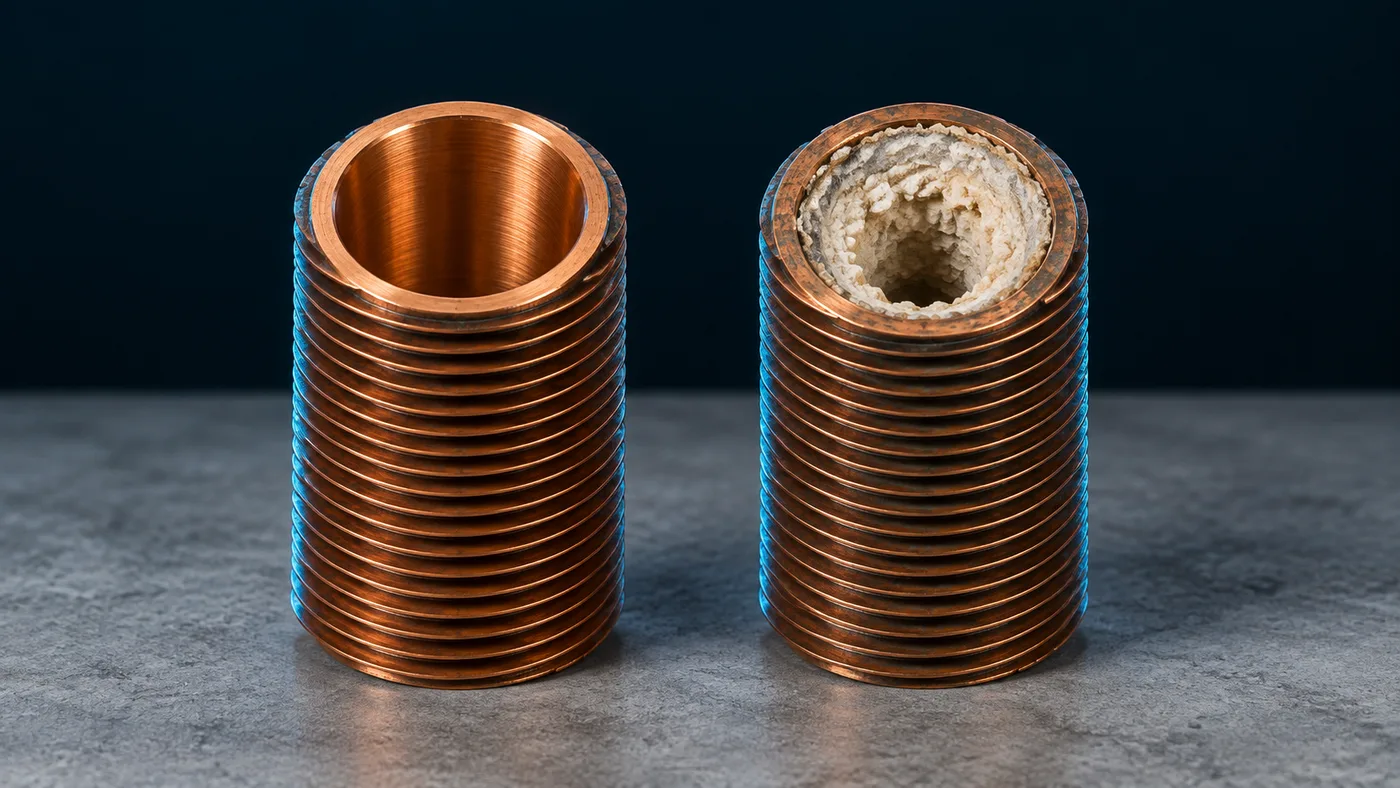
HLS — high limit after the first pass. The heater is making heat faster than the water is carrying it away. If flow checks out, the exchanger is the next stop. Scale on the inside of the copper tubes is the classic cause in hard-water regions: the water inside the tube is insulated from the tube wall, the wall runs hot, and the limit trips. Look for the secondary evidence — a heater that has been "running hot" for a season, a pool with high calcium hardness, previous HLS codes that cleared on a reset and came back.
AGS — automatic gas shutoff. Same physics as HLS, measured after the second pass and set a few degrees higher. When you see AGS after HLS has been showing up intermittently, the exchanger is telling you it has crossed from "restricted" to "in trouble." The AGS device itself must never be bypassed; a persistent AGS after flow is verified means the exchanger and the thermal regulator need to be looked at, not the switch.
Two parts sit at the centre of the water side, and both are aftermarket work.
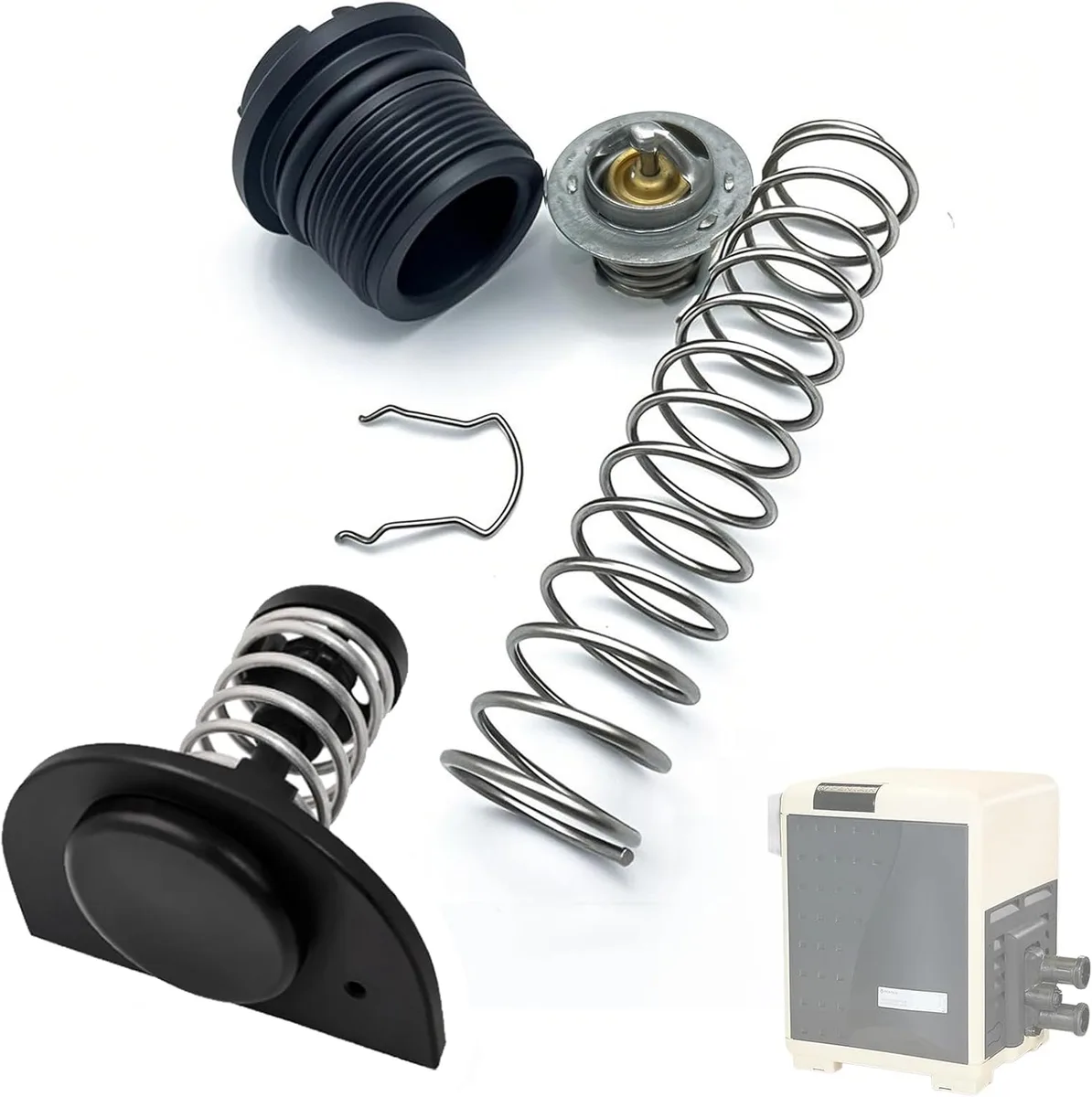
The thermal regulator is a wax-element valve inside the manifold that holds the exchanger at operating temperature by bypassing part of the flow until the water warms up. When it sticks, the exchanger either never reaches temperature or is starved of flow at the wrong moment, and the heater throws HLS codes on a pool that has perfect flow everywhere else. The 77707-0010 regulator fits the MasterTemp 125 through 400 and the Sta-Rite units; it is also available as a regulator-and-bypass-valve kit for a complete manifold refresh.
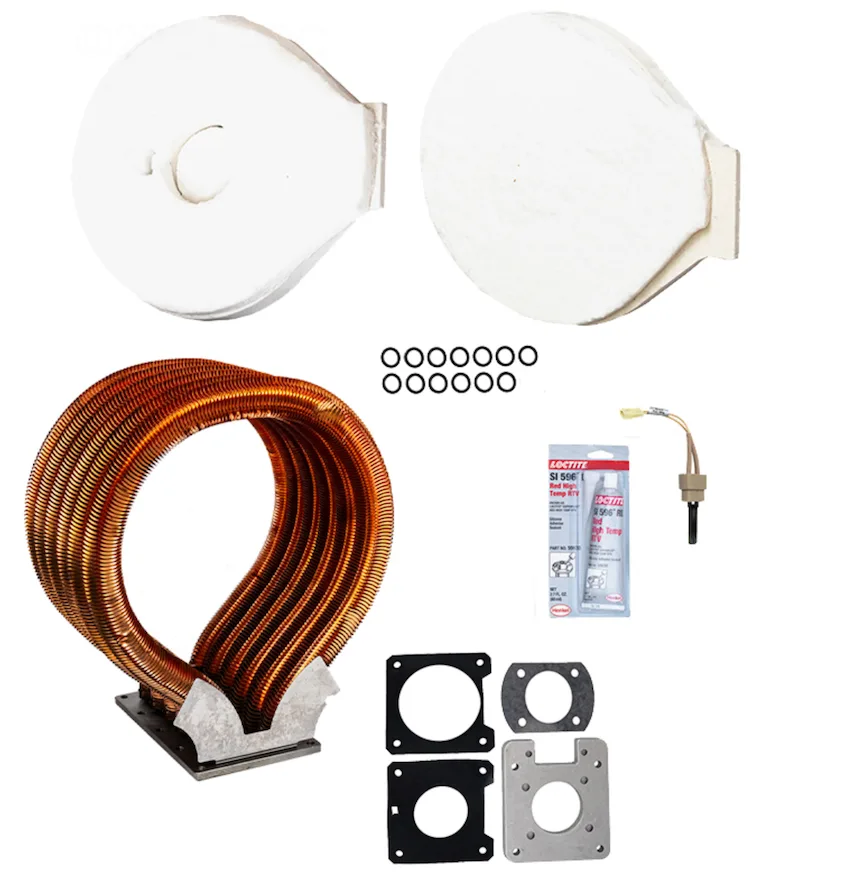
The heat exchanger is replaced as a tube-sheet coil assembly. Scaled tubes can sometimes be acid-flushed once; a tube that has been overheated, pitted from low pH, or is leaking at the header gasket is a replacement. Match the assembly to the model and fuel: 77707-0233 for the Max-E-Therm SR333, 77707-0234 for the 400 natural gas and propane units, 474063 for the MasterTemp 250HD, and 460747 for the 250,000 BTU unit as a complete assembly.
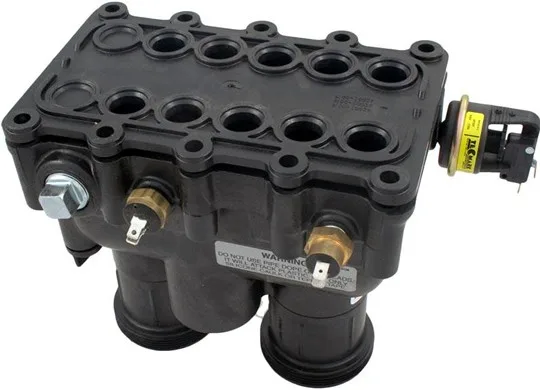
When the exchanger comes out, the manifold is off anyway. If the header face is corroded or the bypass seat is worn, replace the manifold kit at the same time rather than reusing it: 77707-0014 for the 200,000 BTU, 77707-0015 for the SR333, 460748 for the 250,000 BTU and 474972 for the MasterTemp 125.
The air side: AFS, SFS, E05 and E06
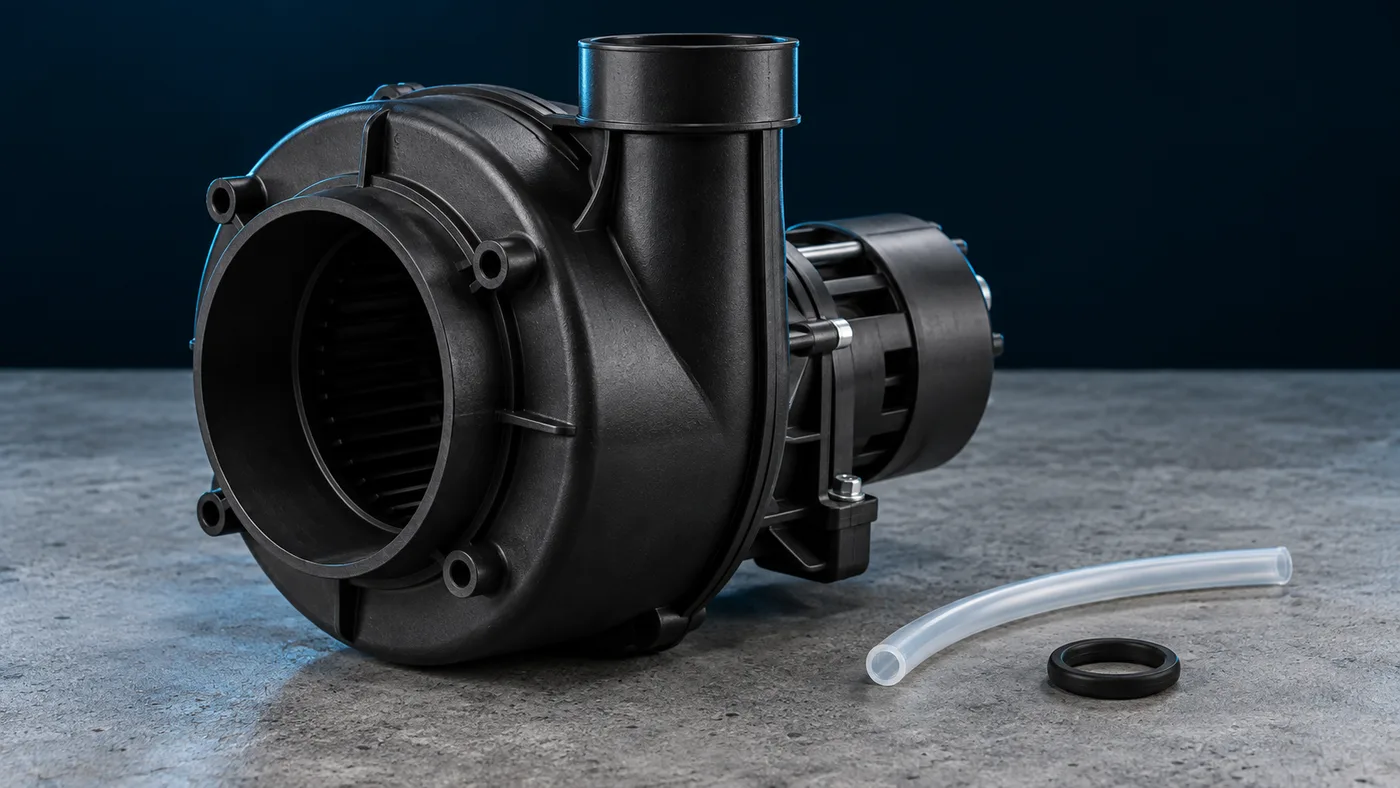
AFS — air flow switch open. The combustion blower must prove it is moving air before the gas valve is allowed to open. The switch senses that through a small silicone pressure-tap tube. When AFS appears: is the blower spinning at all, is the tube connected at both ends and free of cracks or water, is the exhaust clear? A vent blocked by a wasp nest or leaf litter looks exactly like a failed blower to the controller. A blower motor that will not start, hums, or has a rough bearing is a replacement, and the blower assembly is a normal aftermarket part. Match by BTU rating and fuel: 460743 for the 250,000 BTU natural gas MasterTemp, 77707-0253 for the 400 natural gas, 77707-0254 and 77707-0256 for the 200 and 400 propane units, 77707-0252 and 77707-0255 for the SR333 natural gas and propane. Replace the blower-to-adapter-plate gasket kit 77707-0011 any time the blower comes off; a leak at that plate skews the pressure the switch is reading.

SFS — stack flue temperature exceeded. Normal vent gas on these units stays well under 400°F; the sensor trips around 480°F. A genuine SFS means the exchanger is not absorbing heat — sooted fins, scaled tubes, or a combustion problem pushing too much heat up the stack. Clean the exchanger fins and check the burner before blaming the sensor.
E05 and E06 — flue sensor open or shorted. These are not temperature events; they are circuit faults. The sensor lives in the exhaust path where heat and acidic condensate attack the wire insulation and the connector. Check the harness and connector first, then the sensor's resistance against the manual. E06 on a heater that has just had a board changed can also be a board set for the wrong sensor type. The sensor and the board are OEM parts.
The gas side: IGN
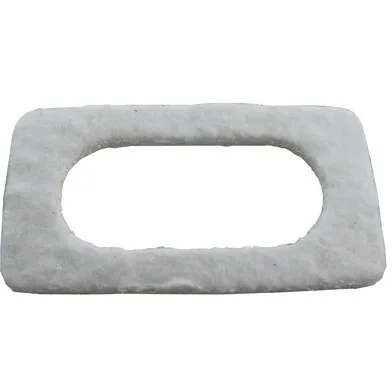
IGN means the ignition control tried to light the burner and did not prove flame within its window. Working from the outside in: gas supply on and at pressure under load, the igniter glowing on a call for heat, flame sense clean and grounded, ignition module output present. Every one of those components — gas valve, hot-surface igniter, flame sensor, ignition control — sits inside the appliance's gas train and certification boundary, and we do not manufacture or supply them. The one item in that area that is ours is the igniter gasket 42001-0066S, which seals the igniter to the combustion chamber and should be renewed whenever the igniter is removed for inspection. Likewise the combustion chamber gasket kit 474952 and combustion chamber cover 474958 on the MasterTemp 125 are sealing and structural parts, not gas-train parts.
Sensor circuits: E01 and 126
Both refer to the water temperature thermistor in the inlet header: E01 when the circuit is open, 126 when it reads a short. The controller cannot regulate without it, so it refuses to run. Check the connector at the board and the wire run for chafe against the jacket before replacing the sensor, which is an OEM part. If the display itself is misbehaving, see the note on the membrane pad above.
What is aftermarket work and what is OEM-only
We wrote a longer piece on why gas-train and safety components should stay with the equipment brand. The short version for this heater:
OEM-only: pressure switch, high-limit switch, AGS switch, stack flue sensor, water thermistor, hot-surface igniter, flame sensor, ignition control module, gas valve, control board and membrane pad. Every one of these either meters gas or exists to shut the heater down when something is wrong, and its failure mode is part of the appliance certification.
Aftermarket work: heat exchanger tube-sheet coil assemblies, manifold kits, thermal regulator and bypass valve, combustion blower assemblies and their gaskets, combustion chamber gasket and cover, igniter gasket, heater top 42002-0034Z and jacket hardware, and the on/off switch 471128. These are sealing, structural and flow components. They wear, they scale, they corrode, and replacing them does not alter how the heater proves flame or shuts itself down.
That split also happens to match where the money is on a service truck. Switches and sensors are inexpensive OEM items you carry a few of. Exchangers, manifolds and blowers are the parts that decide whether a fifteen-year-old heater is worth saving, and where an aftermarket price makes the repair viable.
Cross-reference table
| OEM number | POOLPOINT part | Notes |
|---|---|---|
Sta-Rite 77707-0010 / 38000-0007S / 262506 |
77707-0010 |
Thermal regulator, MasterTemp 125–400 and Max-E-Therm |
Sta-Rite 77707-0001 |
77707-0001 |
Manifold bypass valve kit |
Sta-Rite 77707-0010 + 77707-0001 |
77707-0010 kit |
Regulator and bypass valve as one kit |
Sta-Rite 77707-0233 |
77707-0233 |
Tube sheet coil assembly, SR333 |
Sta-Rite 77707-0234 |
77707-0234 |
Tube sheet coil assembly, 400 NA and LP |
Pentair 474063 |
474063 |
Tube sheet coil assembly, MasterTemp 250HD |
Pentair 460747 |
460747 |
Heat exchanger assembly, 250,000 BTU |
Sta-Rite 77707-0014 |
77707-0014 |
Manifold kit, 200,000 BTU |
Sta-Rite 77707-0015 / 77707-0016 / 77707-0205 |
77707-0015 |
Manifold assembly, SR333 |
Pentair 460748 |
460748 |
Manifold kit, 250,000 BTU |
Pentair 474972 |
474972 |
Manifold kit, MasterTemp 125 |
Pentair 460743 |
460743 |
Combustion blower kit, 250 NG |
Sta-Rite 77707-0253 / 77707-0256 |
77707-0253 / 77707-0256 |
Blower kit, 400 NG / 400 LP |
Sta-Rite 77707-0254 |
77707-0254 |
Blower kit, 200 LP |
Sta-Rite 77707-0252 / 77707-0255 |
77707-0252 / 77707-0255 |
Blower kit, SR333 NG / LP |
Sta-Rite 77707-0011 |
77707-0011 |
Blower and adapter plate gasket kit |
Sta-Rite 42001-0066S / 6290-050 |
42001-0066S |
Igniter gasket |
Pentair 474952 |
474952 |
Combustion chamber gasket kit, MasterTemp 125 |
Pentair 474958 |
474958 |
Combustion chamber cover |
Sta-Rite 42002-0034Z |
42002-0034Z |
Heater top |
Pentair 471128 |
471128 |
On/off switch |
The full list of parts that fit is on the Sta-Rite MasterTemp, Pentair MasterTemp and Max-E-Therm model pages.
Sourcing
POOLPOINT manufactures the sealing, structural and flow components above factory direct for US distributors, service companies and online sellers. MOQ starts at 50 pieces per SKU, mixed cartons are accepted to reach it, and private label is available. We do not supply gas-train, ignition or safety components for any heater, and will say so if asked. Request a quote for wholesale pricing on the parts we do make.